7 Shadia Films That Remind Us Why She’s an Icon
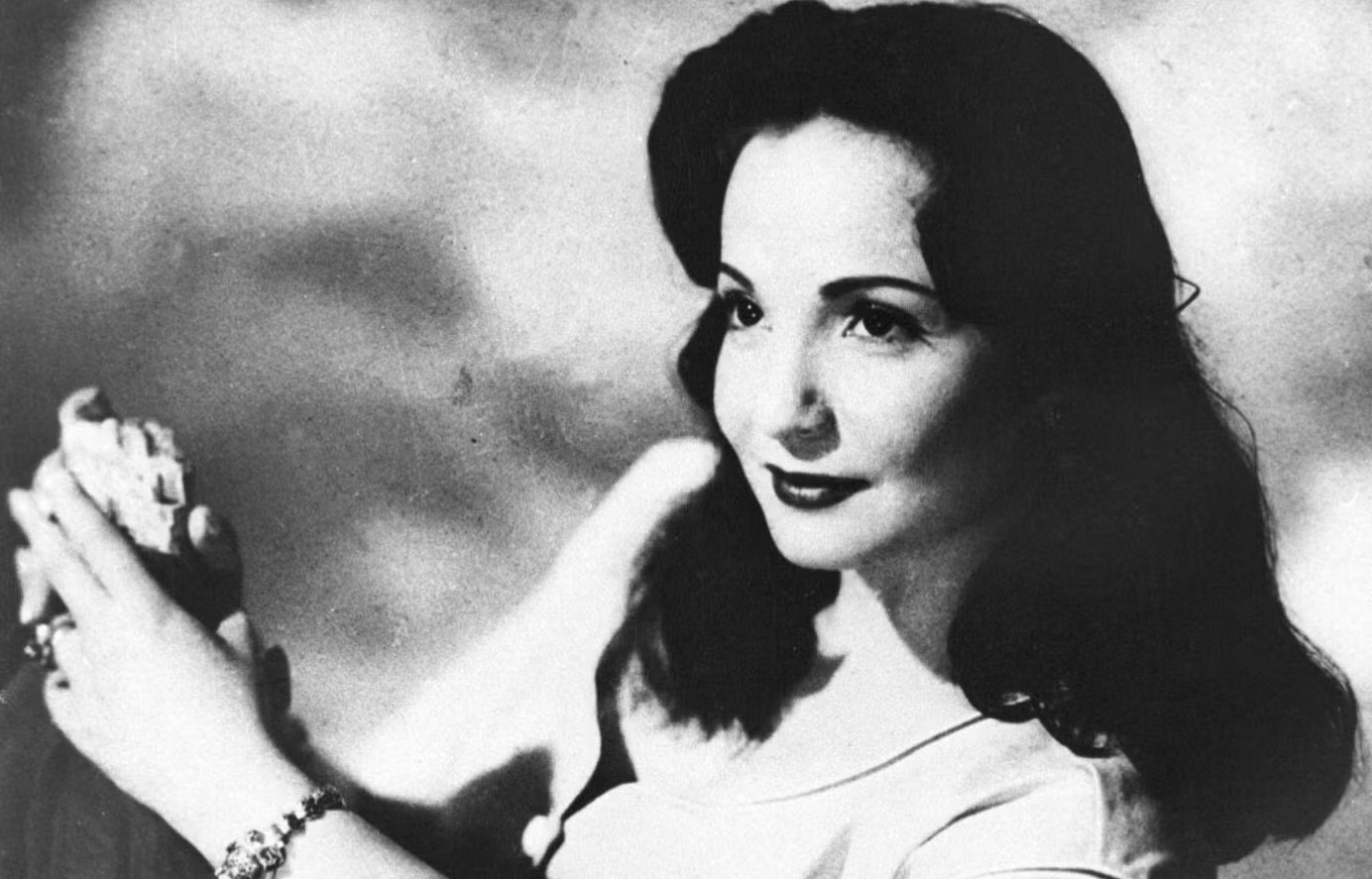
With Shadia taking center stage in the official poster for the 47th Cairo International Film Festival, it’s the perfect time to revisit some of the roles that made her one of Egyptian cinema’s most unforgettable stars.
From women who challenged the rules to complicated love stories and characters who refused to be pushed around, Shadia gave us performances that have stayed with us long after the credits rolled. And honestly, some of these stories feel just as relevant today as they did decades ago.
In the spirit of CIFF’s celebration of Egyptian cinema’s legacy, here are seven of our favorite Shadia films that remind us why the stories we preserve are the ones that keep inspiring us.
Emraa Fi Dawama: A Family Drama Full of Twists
Some family secrets make for good drama. This one has enough twists to keep an entire family therapist busy.
In Emraa Fi Dawama, Shadia plays Nadia, a young woman whose life takes a devastating turn after her fiancé dies in an accident, leaving her pregnant. When Nadia gives birth to a baby girl, her mother makes the desperate decision to replace the newborn with a deceased baby, and little Fathia is raised in the home of a wealthy man, unaware of the truth surrounding her birth.
As Nadia moves on and falls in love again, her path crosses with her daughter’s, setting the stage for a complicated story of secrets, sacrifice, and family ties.
It’s the kind of melodrama that pulls you into its web of impossible choices, reminding us why classic Egyptian cinema knew how to keep audiences hooked.
Karamet Zawgaty: When the Wife Plays by Her Own Rules
What happens when a man who has spent years avoiding commitment finally gets married, only to discover that his wife has absolutely no intention of putting up with his nonsense?
In Karamet Zawgaty, Mahmoud eventually convinces Nadia, his longtime colleague, to marry him. She agrees on one condition: if he cheats, she’ll do the same. When his infidelity comes to light, Nadia starts behaving in ways that leave him questioning everything.
The setup is a recipe for marital chaos, but it also gives us a woman who refuses to quietly accept a double standard. And considering how much relationship discourse still fills our timelines today, Nadia’s approach to marriage feels like it could inspire a few very lively group-chat debates.
Moawad Ma Al Hayat: Love, Sacrifice and a Heartbreaking Secret
Shadia wasn’t just a queen of drama. She also knew how to bring warmth, charm and a little romance to the screen.
In Moawad Ma Al Hayat, she plays Fatima, a lively young woman who lives with Amal (Faten Hamama), whose story takes a more dramatic turn when she discovers she has a serious heart condition. While Amal navigates her complicated love life, Fatima has her own romantic interest in Dr. Mamdouh (Omar El-Hariri). By the end, Amal gets a second chance at life following successful surgery, while Fatima gets her happy ending by marrying Mamdouh.
It’s a lovely glimpse of Shadia’s lighter side, showing the charm and romantic energy she brought to the screen alongside her more dramatic performances. Because even an icon known for her emotional range knew how to make us smile.
Al Hareba: A Woman Who Refuses to Let Others Choose Her Future
Sometimes, the most radical thing a woman can do is simply decide what happens next in her own life.
In Al Hareba, a young woman escapes a forced marriage and heads to Cairo to start over. There, she finds love with a doctor, but building a new life proves difficult when society and circumstance keep getting in the way.
The story taps into something that remains deeply resonant: a woman’s right to choose her own future, even when the world around her has other plans. Shadia’s filmography was full of women navigating the limits placed on them, and this story is another reminder that independence has never been a one-size-fits-all journey.
Shey’ Min Al-Khouf: The Woman Who Stood Up to a Tyrant
If there’s one thing Fouada teaches us, it’s that love is no excuse for letting someone control your life.
Set in the fictional village of Dahashna, Shey’ Min Al-Khouf follows Atrees, a man who inherits his grandfather’s cruelty and turns it into a reign of terror over the villagers. He has loved Fouada since childhood, but she refuses to marry him after witnessing the tyrant he has become. Her public defiance challenges not only Atrees but the fear that has kept the entire village under his thumb.
Fouada’s resistance becomes a symbol of collective courage, showing how one person’s refusal to submit can inspire an entire community. It’s a powerful role for Shadia, and one that speaks to the enduring power of cinema to turn an individual act of defiance into a story that belongs to everyone.
Merati Modeer Aam: When His Wife Becomes the Boss
A wife gets promoted to general manager at the company where her husband works. Naturally, things get awkward. Very awkward.
In Merati Modeer Aam, Esmat Fahmi lands the leadership position, leaving her husband Hussein struggling to reconcile her professional success with his own expectations. He initially hides their marriage from their colleagues, but the situation soon becomes impossible to manage.
Released in an era when women’s access to leadership positions was still a major social question, the film used comedy to poke at the insecurities behind traditional gender roles. Esmat doesn’t need to become less capable to make her husband more comfortable, and the joke ultimately lands on a society that struggles to accept a woman in charge.
The film is widely regarded as one of the landmarks of Egyptian social comedy and is included among the 100 best films in the history of Egyptian cinema. Decades later, its workplace dynamics still feel surprisingly familiar. Turns out, some office politics never really go out of style.
Enta Habibi: From a Marriage of Convenience to a Love Story
Before the fake-dating trope took over our screens, Egyptian cinema was already having fun with relationships that start for all the wrong reasons.
In Enta Habibi, a man and a woman find themselves in a marriage of convenience, only to gradually develop genuine feelings for each other. What begins as an arrangement becomes a romantic comedy about two people discovering that love doesn’t always follow the plan.
It’s a lighter side of Shadia’s filmography, but an equally important one. She could move between emotional dramas, social satire, and romantic comedy without losing the charm that made audiences connect with her. And honestly, watching two people accidentally fall for each other will probably never stop being entertaining.
The Stories We Keep Are the Stories That Keep Inspiring Us
Shadia’s legacy isn’t just about the number of iconic films she left behind. It’s about the women she brought to life: the ones who pushed back against injustice, questioned expectations, made difficult choices, and sometimes simply wanted to be loved on their own terms.
That’s what makes the official poster for the 47th Cairo International Film Festival feel so fitting. By bringing an image from Egyptian cinema’s past into the present, it reminds us that preserving a film is about more than keeping a piece of history intact. It’s about giving its stories another chance to reach us, move us, and inspire the next generation of filmmakers.
And if Shadia’s unforgettable characters are any indication, Egyptian cinema still has plenty to say. Some scenes stay with us for a reason.