7 Films That Show Palestine’s Story Started Long Before October 7
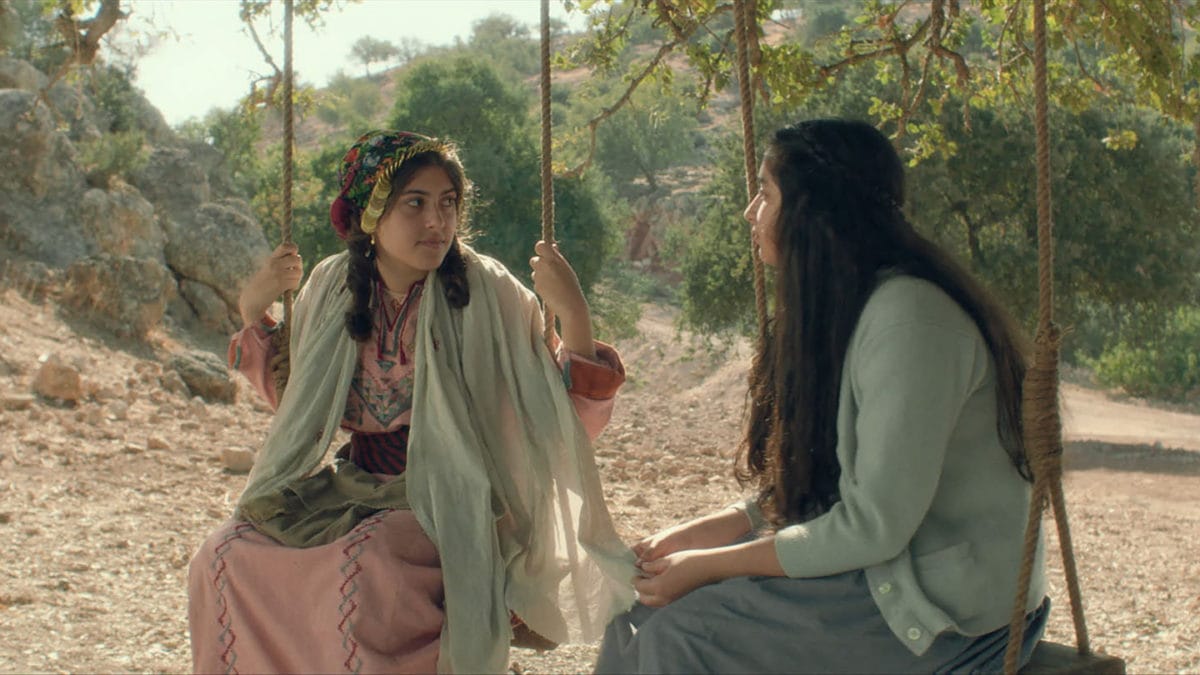
October 7 is often treated in Western coverage as the moment the story began, as if Palestine’s history can be neatly divided into a “before” and “after.” But for Palestinians, the story stretches back decades: through the Nakba, displacement, occupation, land confiscation, forced expulsions, imprisonment, and generations of resistance.
These films offer a way into that longer history. From 1948 to the present day, they tell Palestinian stories through families, love, memory, land, and everyday life, reminding us that what happened on October 7 did not happen in a vacuum.
1 Pomegranates and Myrrh
Set between Jerusalem and the West Bank, Pomegranates and Myrrh follows Qamar, a newlywed Palestinian woman whose husband, Zaid, is imprisoned after confronting the confiscation of his family’s olive land.
With Zaid behind bars and their harvest under threat, Kamar returns to dancing, joining a traditional Palestinian dance troupe. Her growing connection with its new choreographer, Kais, forces her to confront not only her feelings but also the expectations placed on her as the wife of a prisoner.
Directed by Palestinian filmmaker Najwa Najjar, the film makes the occupation impossible to separate from everyday life. Olive groves, checkpoints, prison walls, and divided cities become part of the story, showing how occupation reaches into something as personal as marriage, family, and identity.
At its heart, it’s a story about Palestinian land, resistance, and the struggle to remain yourself when so much around you is designed to restrict you.
2 The Shadow of the West
Narrated by Palestinian-American intellectual Edward Said, The Shadow of the West looks at the way the Arab world, and particularly Palestinians, have been portrayed through Western eyes.
The documentary traces centuries of Western representations of the “Orient,” from historical accounts and paintings to modern political narratives, questioning how these portrayals have shaped the way Arabs and Palestinians are understood.
Palestine becomes the clearest example of this disconnect between representation and reality. One particularly striking moment features Jewish tourists visiting a historical site in Palestine, with one American visitor arguing that Palestinians should simply find somewhere else to live in the Arab world.
Said’s response cuts to the heart of the issue: who gets to decide who belongs to a land?
The film is worth watching for that reason alone; it doesn’t just examine Palestine’s history, but the narratives that have been used to explain, justify, or erase it.
3 Salt of This Sea
What happens when a Palestinian descendant tries to reclaim what was taken from her family?
That’s the question at the center of Salt of This Sea, Annemarie Jacir’s debut feature. Soraya, a Palestinian-American born to refugee parents, travels to Palestine after discovering that her grandfather’s savings have been frozen in a Jaffa bank since his exile in 1948.
Her arrival quickly exposes the restrictions placed on Palestinians. She is subjected to intense questioning at the airport, while Emad, a Palestinian man she meets in Ramallah, is repeatedly denied a visa to leave for Canada.
Together, they begin pushing back against the borders and systems controlling their lives.
The film is angry, but it is also deeply human. It’s about Palestinians trying to reclaim more than money or land; they’re trying to reclaim the freedom to move, return, dream, and simply live.
4 The Time That Remains
Elia Suleiman’s The Time That Remains tells the story of a Palestinian family across four generations, beginning with the Nakba in 1948 and continuing into the present.
Inspired partly by Suleiman’s own family history, the film moves through his father’s experiences during the Nakba, his mother’s letters to relatives forced into exile, and the everyday lives of Palestinians who remained in their homeland and later became known as “Israeli Arabs.”
Rather than presenting history as a series of dates and political events, Suleiman shows how it lives inside families.
There’s grief, absurdity, silence, and dark humor, but beneath it all is the same question: what does it mean to remain on your land while watching the world around you change?
It’s a deeply personal look at a history that is anything but distant.
5 No Other Land
If you want to understand what life under occupation looks like today, No Other Land is essential viewing.
The Oscar-winning documentary follows Palestinian activist Basel Adra as he spends years documenting the destruction of his community in Masafer Yatta in the occupied West Bank.
Along the way, he develops an unlikely friendship and filmmaking partnership with Israeli journalist Yuval Abraham. Together, they document demolitions, displacement, and the struggle of Palestinians trying to remain on their land.
What makes the film so powerful is its immediacy. This isn’t history being retold decades later. It is people filming what is happening to their homes as it happens.
At its core, No Other Land is about forced displacement, resistance, and the fight to remain.
6 Palestine 36
Before 1948. Before the Nakba. Before the borders and realities we associate with Palestine today, there was the Palestinian uprising of 1936.
Palestine 36 takes viewers back to that period, following Yusuf as villages across Palestine rise against British colonial rule. As he moves between his rural home and Jerusalem, the political unrest around him becomes increasingly impossible to escape.
The film captures a crucial chapter of Palestinian history: the mass revolt against British rule and the growing tensions surrounding Zionist immigration and colonisation.
It’s a reminder that Palestinian resistance did not begin in 1948, and certainly did not begin on October 7.
7 Farha
Set during the Nakba in 1948, Farha follows a 14-year-old Palestinian girl whose dreams of leaving her village to pursue an education are shattered when violence reaches her home.
Farha is locked inside a small storage room by her father for her own protection. From there, she watches and hears the destruction unfolding outside.
The film puts the Nakba into deeply personal terms. Rather than presenting it through statistics or political speeches, we experience it through one teenager trapped in a room, waiting and listening as her world disappears.
It’s a difficult watch, but an important one, especially for anyone whose understanding of Palestine begins with October 7.
Why These Films Matter
Watching these films around October 7 isn’t about ignoring what happened that day. It’s about refusing to treat it as the beginning of the story.
Palestinian cinema has been documenting displacement, occupation, land confiscation, imprisonment, and the destruction of Palestinian communities for decades. From the Nakba of 1948 to the uprising of 1936, from life under occupation to the ongoing destruction of Palestinian homes and land, these stories existed long before October 7.
And perhaps that’s what makes them worth watching now. Because understanding October 7, and everything that followed, also means understanding the history that came before it.